Thai Dessert Heritage
About Us
Where Old Recipes Find a New Life
There is something rather special about an old Thai dessert recipe.
It may be nothing more than a few lines of faded type on a small postcard, a list of ingredients written in an older style of Thai, and instructions that assume the reader already knows what to do. Yet somehow, these little pieces of paper carry much more than a recipe.
They carry a glimpse of another time.
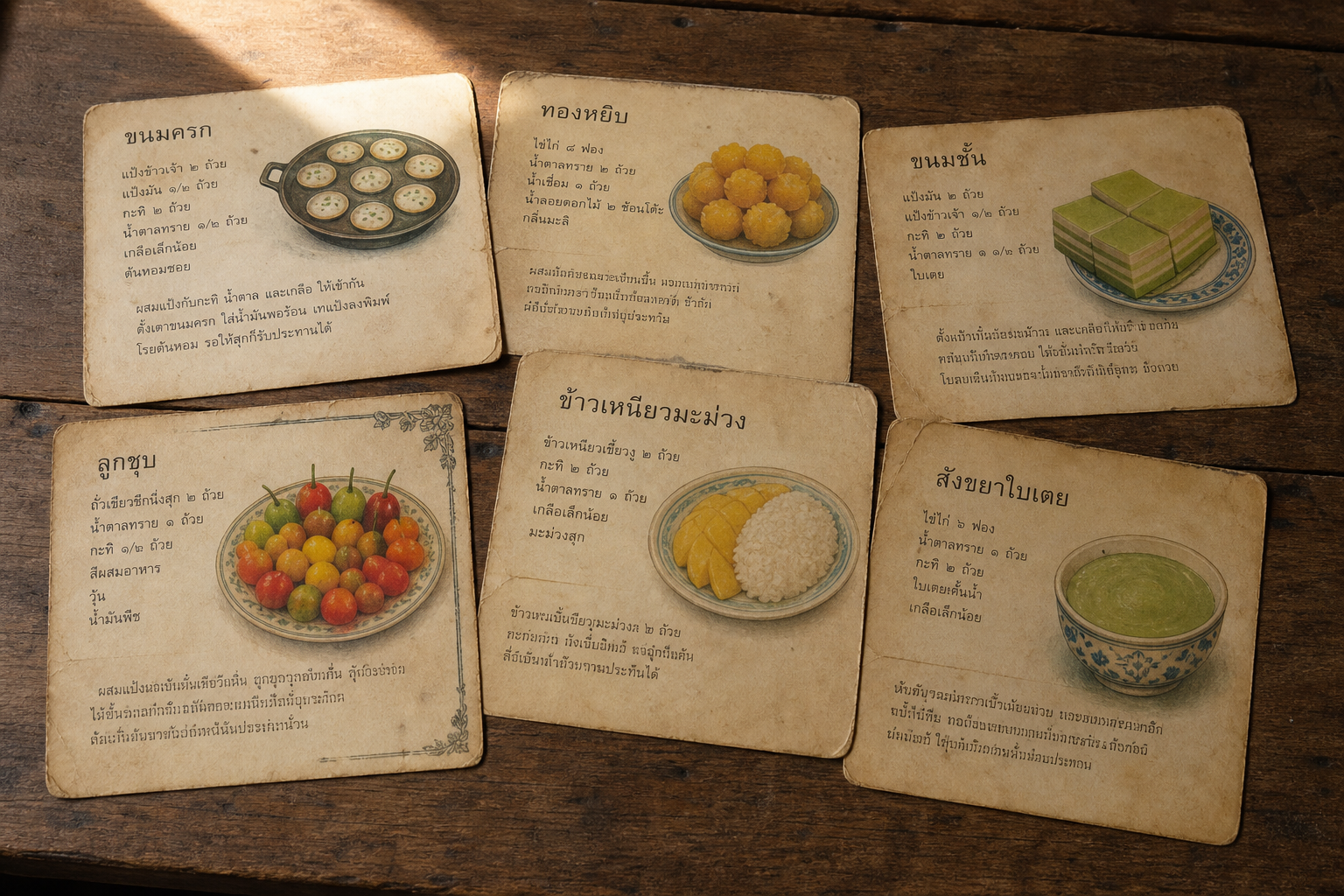
Our collection began with an appreciation for these traditional recipe postcards — small, beautifully preserved pieces of everyday Thai culture that recorded the making of sweets in a way that feels wonderfully personal today. The language, the measurements, the utensils, and even the way the instructions were written tell their own story.
Some recipes are familiar. Others have almost disappeared from everyday kitchens.
We felt they deserved to be remembered.
So this project began as an attempt to give these old recipes a second life. Rather than leaving them quietly in a collection, we are bringing them into a digital space where anyone can explore them — whether they are in Thailand, halfway around the world, or simply curious about the flavours and traditions of Thai desserts.
Preserving More Than a Recipe
Thai desserts have always been closely connected with the way people lived.
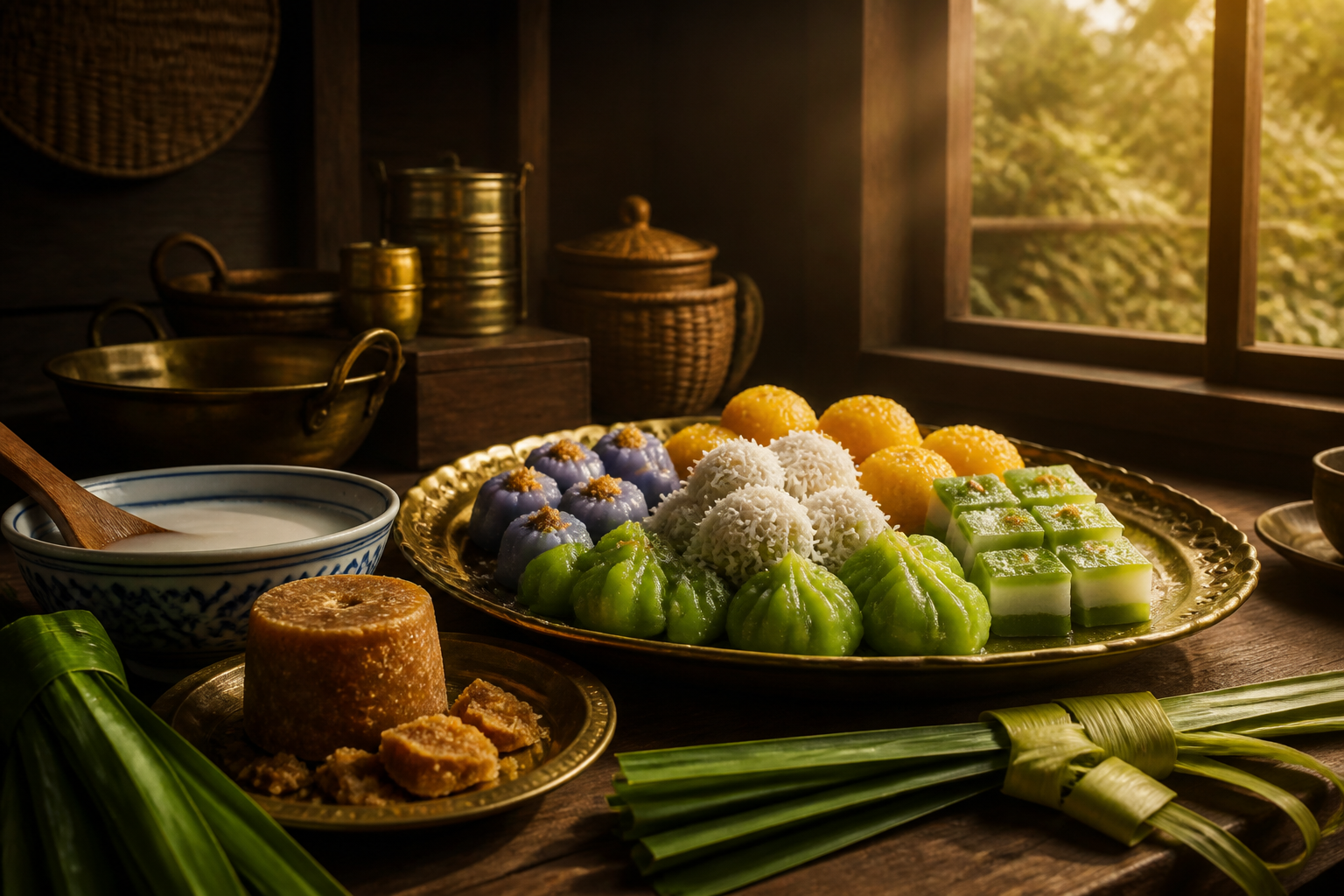
Coconut, palm sugar, mung beans, rice flour, pandan, jasmine and fragrant flowers were not simply ingredients. They were part of the landscape, the seasons, the household, and the occasions for which these sweets were prepared.
A recipe can tell us what went into a dessert.
An old recipe can sometimes tell us how people lived.
That is why preserving these recipes matters to us. We want to keep the original character of the collection while making the information easier to understand and use today.
The recipes are carefully organised into ingredients, quantities, methods, preparation notes, and, where relevant, the traditional utensils used in the process. Old measurements and descriptions are clarified where necessary, without losing the character of the original source.
The goal is not to rewrite history.
It is to make history usable.
Thai Desserts, Beyond Language
Food has a curious way of crossing borders.
You do not need to speak Thai to appreciate the colour of a piece of khanom chan, the fragrance of pandan, or the delicate sweetness of a traditional coconut dessert. But language can make it difficult to understand how these things were actually made.
For that reason, the collection is presented in Thai, English, and Chinese.
Translation here is not simply about changing words from one language to another. Traditional recipes often contain assumptions that make perfect sense to someone familiar with Thai cooking but can be confusing to a first-time cook.
We therefore try to explain the recipes clearly enough that someone who has never prepared a Thai dessert before can understand what is happening in the kitchen.
Perhaps that person lives in Bangkok.
Perhaps they live in London, Vancouver, Singapore, or Shanghai.
Either way, the recipe should still make sense.
When the Classic Meets the Digital
There is a small contradiction at the heart of this project.
The original recipes belong to paper.
We are putting them on screens.
We like that contradiction.
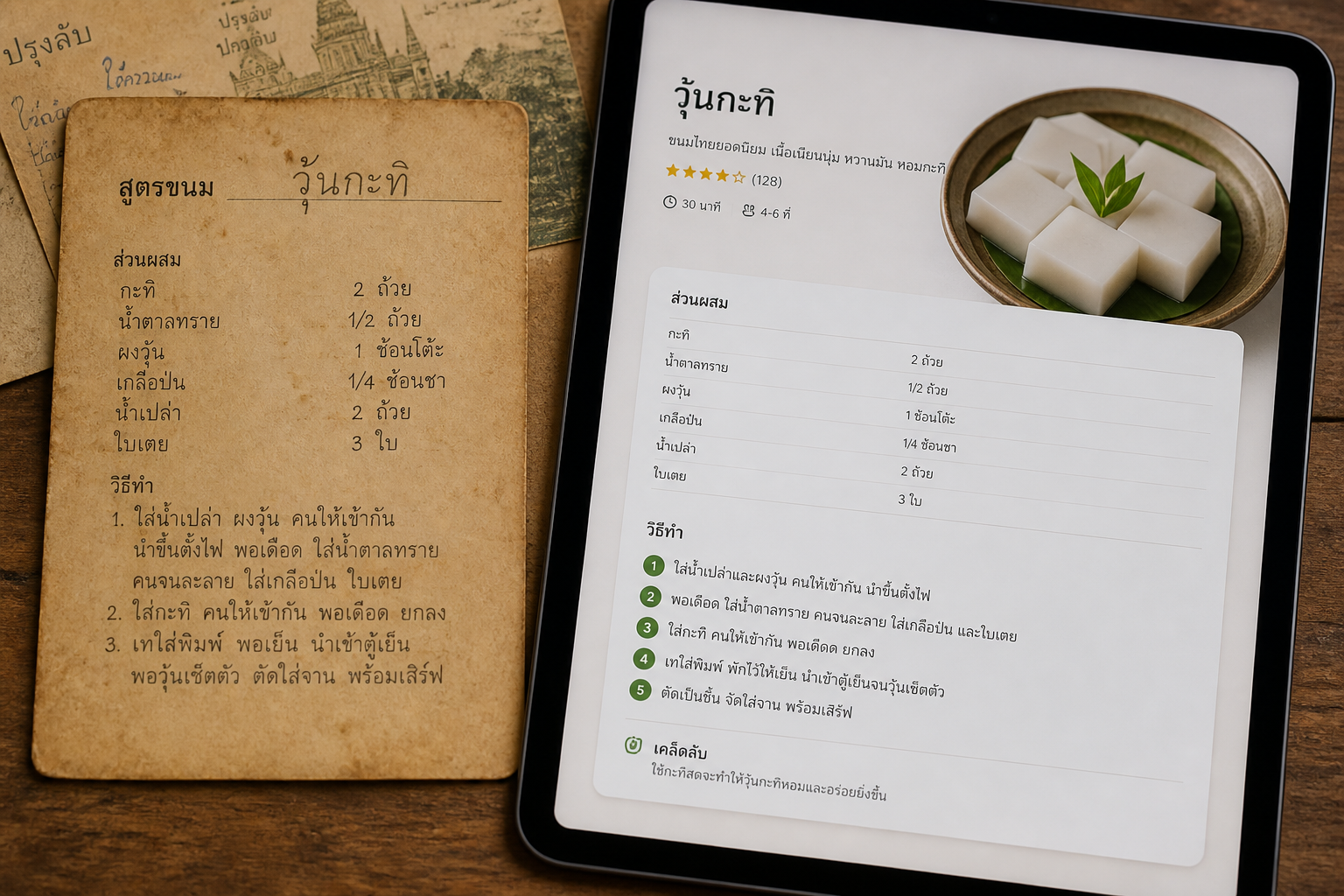
The postcards have their faded colours, old typography, imperfect edges and unmistakable sense of time. The website, meanwhile, is designed to be clean, searchable and easy to use.
We don't want the digital version to replace the postcard.
We want it to lead people back to it.
Every original image is therefore part of the story. The postcard is not merely an illustration for the recipe; it is part of the historical record and the reason the recipe has survived in the first place.
Making Old Recipes Easier to Cook
Traditional recipes can be wonderfully charming.
They can also be slightly mysterious.
A recipe from another era might say to cook something “until ready,” use an unfamiliar measurement, or mention a utensil that is no longer found in most modern kitchens. Anyone who has cooked from an old family recipe will know the feeling.
You read the instructions.
Then you look at the recipe again.
Then you wonder, “How much is that supposed to be?”
We have tried to make these recipes more practical without stripping away their original character.
Ingredients and quantities are structured clearly. Methods are arranged step by step. Traditional utensils and special equipment are identified when they matter to the result. Where an old technique requires a little more explanation, we provide the context needed to understand it.
It is a small act of translation — not only between languages, but between generations.
Why We Keep These Stories
There are thousands of recipes available online today.
Another recipe website is not particularly difficult to make.
What is much harder to replace is an original piece of cultural memory.
A postcard printed decades ago can survive in a drawer long after the person who bought it, cooked from it, or gave it to someone else has disappeared from the story. The paper may fade. The typography may become unfamiliar. But the recipe can still tell us something.
That is what we hope to preserve.
Not just the taste of Thai desserts, but the traces of the people, kitchens, ingredients and traditions behind them.
A Living Collection
This is an evolving collection.
As more recipes, postcards and historical material are discovered, we hope to continue documenting them and making them accessible to a wider audience.
Some recipes may be beautifully familiar.
Some may surprise you.
And some may be recipes that have been waiting for someone to look at them again for a very long time.
We think that is part of the charm.
An old postcard was never meant to live forever. It was meant to travel from one person to another, carrying a small piece of information, affection, or memory along the way.
Today, we are simply giving those little pieces of paper another place to travel.
And perhaps, somewhere along the way, someone will make one of these desserts again — in a kitchen very far from the one where the recipe first began.